abt. 1855-1950, Rutherfordton, Rutherford, North Carolina
Previously: Ervin maintained close relationships with South Carolinians in Cherokee and Spartanburg counties as hinted by a mysterious generosity towards such a family in his last wills and testaments: the Cantrells.
Weldon and Garlin (Gray) Cantrell:
While the Withrows were growing cotton, another young couple living in Cherokee, Spartanburg county somehow captured Ervin’s heart. Speculation abounds as it is unknown whether Ella knew Weldon and Garlin (Gray) Cantrell personally or Ervin knew Weldon’s parents. One of Weldon and Garlin’s living great-grandchildren shared that he was raised by Ervin and Ella. Could the young man have been Ervin’s outside child? Unlikely as that contradicts Weldon’s death certificate and hospital records which consistently name his father as “Early Cantrell.”
Weldon was employed as a mail driver until he was about 60 years old in 1937 when he passed traumatically in the South Carolina State Hospital. A coroner’s report stated that Weldon expired from “general paralysis of the insane” after three months of being committed to the hospital by his son who described him as being uncontrollable and threatening to their family. That son explained that Weldon had suffered an head injury around 1907 and in 1922 had fallen feverishly ill likely from an infectious disease rampant in the United States then.
However Ervin was connected to this man, he bequeathed all his estate to Weldon’s widow and eight children. That was no disrespect to Ella as she had sadly passed a month and two weeks prior to the 1940 census. In 1943, Ervin’s will cited Weldon’s youngest son and four daughters as his beneficiaries; they were all in Chesnee, Spartanburg. But his school teacher niece contested the designations during his 1950 probate since Weldon’s children resided in Spartanburg and were not Ervin’s siblings’ children. Therefore, they’d be ineligible to inherit his North Carolina property. She claimed to be the only educated niece (or nephew) of Ervin, thus qualified to be a self-appointed administrator of his estate. She later renounced that petition and the disbursements proceeded as Ervin desired.

After another return to the Rutherford Hospital receiving strong antibiotics for an undisclosed condition, Ervin passed there on March 9, 1950. As the oldest member of the Wells Springs Methodist Church in Forest City, he was eulogized there on March 11, 1950 with church historian Henrietta C. Twitty reading his obituary; he was laid to rest in the historic church’s cemetery.
Ervin, the well-respected old Negro, was the subject of HR 991, NC House 1939 bill introduced by Henry Grady Withrow, son of the enterprising merchant Julius Plato Durham Withrow and a great-grandson of my 2X great-grandparents’ slave owners.1 It was “to place Irvin Withrow, Negro body servant, on Confederate pension rolls.” In 1939 on the precipice of World War II, Ervin would have been about 82 years, farming throughout the Great Depression and too old to work in New Deal programs available in western North Carolina. Two years later, Rep. Grady Withrow introduced a bill to give the state’s 165,000 seniors aged 65+, a $15 monthly pension.
If Grady’s HR 991 bill had passed, it’s questionable if the Confederate body servant’s pension of $25 annually would have been awarded to Ervin since he was so young to serve as an officer’s camp assistant. By his Rutherford News eyewitness report, he had helped care for James Withrow’s injured sons on the plantation when they returned from the War. Nevertheless, was Withrow’s bill a matter of conscience, a personal acknowledgment of Ervin’s service to that influential clan that profited from the peculiar institution? Did it signal a disconcerting “climate change” in race relations in Rutherford and Cleveland counties, still hotbeds for Ku Klux Klan activities and influence? I have not found pension cards for Ervin so it’s likely the bill didn’t pass.
Meeting Withrow Enslavers’ Descendants, Hollis NC, Oct 2022


Ervin and Beverly (Withrow) Tallent, great-granddaughter of TJ Withrow, enslaver, about 1942, donated by Sarah W. Duncan
In connecting with family historians descended from the Withrow enslavers, I have discovered more about Rutherford County, North Carolina than my father (who was born there) shared. The impact of the transatlantic slave trade on my personal heritage can no longer be intellectually and remotely recognized. Fortunately, the lack of stories from my elders’ lips about their southern upbringing prompted a curiosity for facts beyond my father’s stark memory of seeing KKK cross(es) as a child.
As we say in African tradition, “It takes a village to raise a child,” even so it takes a cross-ethnic (genealogy) community to discover, acknowledge, correct and contribute to all of American history. Of such a community, Scott Withrow, Robin Withrow Mercer, Sarah Withrow Duncan and Dr. Jerry Withrow have willingly shared their lineages and photos for which I’m grateful.
In October 2022, since I was asked to contribute as a researcher to a documentary film regarding the American white and black Withrows and race relations, I met them and more descendants of those enslavers at their family reunion in Hollis, NC. News clippings and photos about Uncle Ervin were taped by the cash register at the entrance to the family-owned restaurant hosting a hearty lunch. I’m sure that was intended to welcome my cousin Greeley Tyson and me and to share warm memories of Ervin. After lunch, like countless other melanated genealogists who travel to their historical plantations, I walked the stunningly serene, beautiful grounds where my people had toiled in forced labor, unpaid. Reflections of that day are for another post.

Historic Cemeteries
The reunion’s itinerary included visiting my family’s two notable cemeteries, Wells Spring Methodist (Rutherford county) and Brooks Chapel Methodist (Cleveland county) where the white Withrows, young and old, were able to note stones, bottles, plastic flowers that marked my peoples’ graves. I poured libation to the ancestors at Uncle Ervin’s and Uncle Albert’s graves, releasing them to return “home” in Africa and honoring them. Our family’s griot Deacon Jimmy G. Littlejohn at Wells Spring, passionately inspired us to continue preserving our histories as he guided us through the sacred grounds.
However, Saturday’s first visit was to the Mount Harmony Memorial Cemetery in Polkville where I finally saw the graves of Ervin’s enslavers, Rev. James and Erixana (Wells) Withrow, pictured below. All photos of Uncle Ervin that I currently have were given to me by white Withrows and this of him standing between the two graves is striking. More questions. Is it likely another photo op by those who wished to perpetuate the tale that Ervin had been “raised” by James? Does Ervin’s posture indicate affection for his former owners? Or had he mastered the art of disguising true sentiments, a skill crucial to his family’s survival during Reconstruction and Jim Crow? Were these photos evidence of some Lost Cause descendants’ subliminal needs to perpetuate a dogged delusion of southern gentility and generosity towards darker ex-forced laborers?
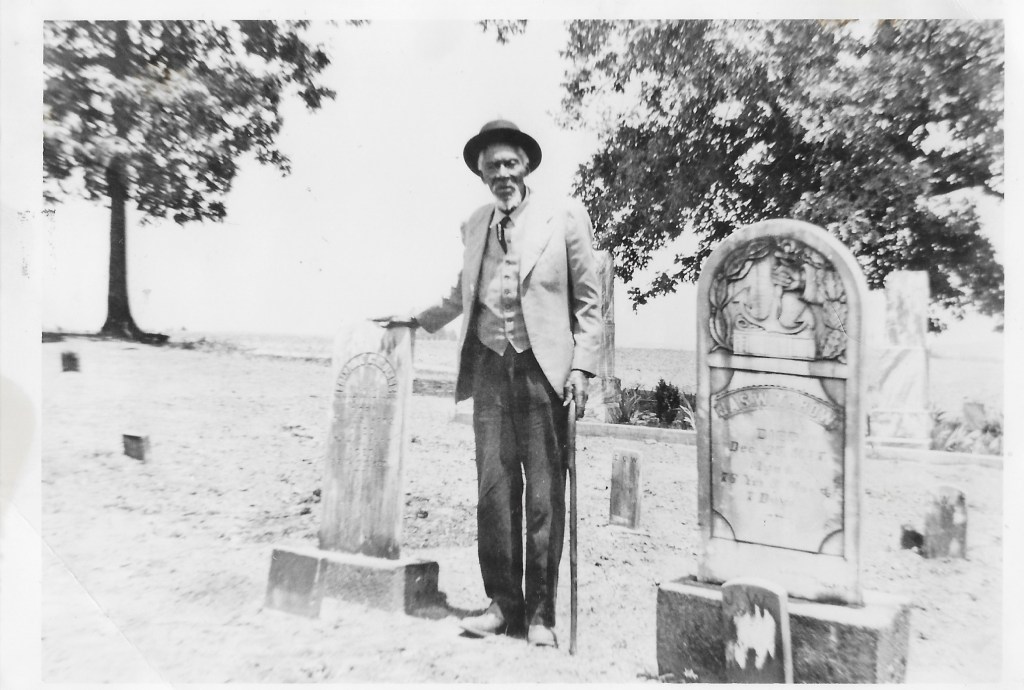
Bill Stone, the Bunbury Films photographer requested I re-enact the pose which frankly, I wasn’t thrilled about but complied to emphasize that this is a new day of discovery, conversation, confrontation and justice. Bunbury producer Kacim Steets Azouz included some of Ervin’s story in his riveting film documentary, What We Inherit (2025) in which he grapples with his own enslaver and cross-ethnic heritages.

“Uncle Ervin,” as he was typically called by the locals, is yet an enigma. Hopefully more oral and written testimonies, artifacts, drawings, documents will be discovered giving us insight into this man’s thoughts and actions, thriving as he did for about a century through the Jim Crow era and several major wars.
Great-granduncle Ervin, you’ve been watched.
- “Legislative Record,” The News and Observer (Raleigh, NC), 25 Mar 1939, page 3, “New House Bills, HB 991 Withrow” ↩︎


Drop a Thought or Question!