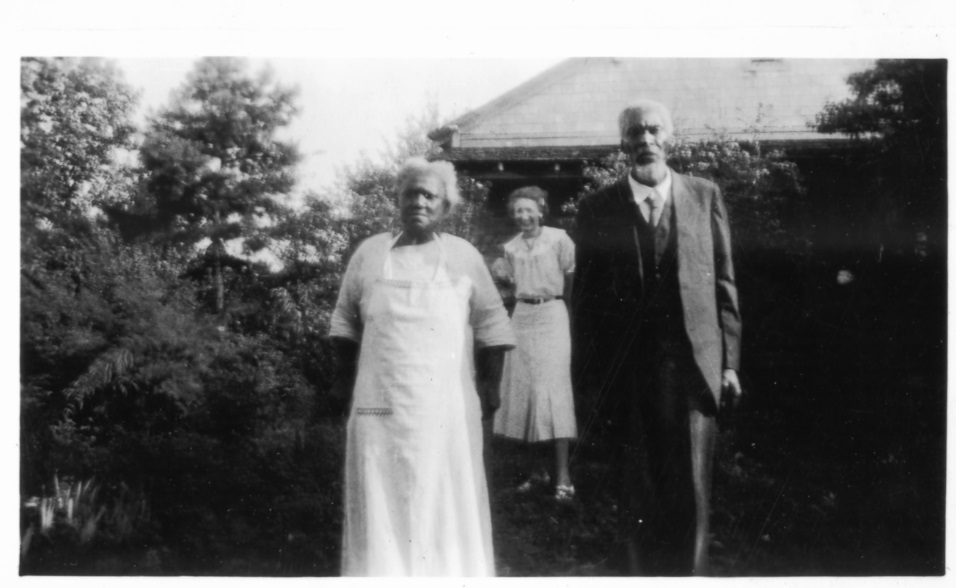
abt. 1855-1950, Rutherfordton, Rutherford, North Carolina
As DNA ancestry tests are popularized with their casually curious customers building family trees, so has ever-expanding online resources become available to researchers’ delight. These tools are major finding aids to explore your family history after you’ve scrounged through boxes in the attic, basement, garage or suddenly remember an envelope handed to you by an elder that’s in one of those moving boxes in storage. Add those personal documents and photos to recordings of oral histories from relatives, friends, neighbors of your ancestors and you’ll have your own story to tell the world.
My story for today begins with just one such yellowing page collated with pages of names printed from a legacy genealogy program. My father’s youngest son had collected names from his back-in-the-day research before genealogists used computers and spent days in courthouses looking up records. Although he focused on his maternal research, he had included a faint clipping that mentioned our great-grand uncle Ervin Withrow, born about 1853 in Rutherford County, North Carolina. Since my paternal grandmother Lizzie Withrow McKinney had passed prior to my birth with no one sharing her history and he was her uncle, that sheet of paper was a mysterious clue. I early attempted to make a career in journalism, so that excerpt of Uncle’s newspaper interview intrigued me far beyond a list of faceless, distant relatives’s names. But I filed it away in a moving box. Until—-
In 2017, I contacted another genealogist who’d posted an Ancestry tree beginning with uncle Ervin’s parents, Isaic and Jennie Withrow. As I correctly presumed, Robin Withrow Mercer is a descendant of my ancestors’ enslavers and having read the same article, was interested in African-American Withrow accounts. She connected me with her historian cousin Scott Withrow who had some research on my family and knew a few personally. It turned out that he was the article’s author! He’d referenced uncle Ervin’s 1937 interview by the Rutherford News in a biography of an ancestor. My father taught me to fish off the Atlantic Ocean’s rocky shores but I never imagined I’d be hooked on seriously researching his lineage until these links came together. Now because of this one record, I had significant insight and evidence into my family’s experience during American chattel slavery.
The fading page included in my brother’s files was copied from The Heritage of Rutherford County, North Carolina, Vol.1, 1984 edited by William B. Bynum, page 445. The book was published by the Genealogical Society of Old Tryon County, Winston-Salem, North Carolina but the Rutherford News local newspaper that interviewed Ervin is defunct. Scott Withrow, as his family’s contributing historian, submitted a brief history of “Rev. James Withrow And The Withrows Of The Civil War Period” and his mention of Ervin echoes the local lore:
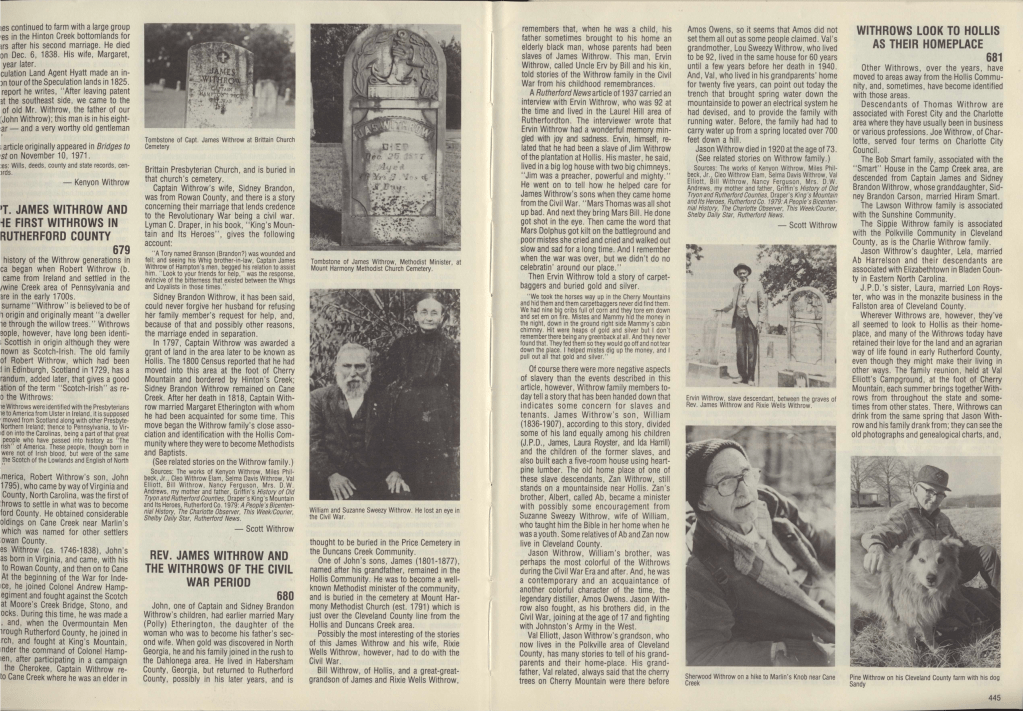
“Bill Withrow, of Hollis, and a great-great grandson of James and Rixie Wells Withrow, remembers that, when he was a child, his father sometimes brought to his home an elderly black man, whose parents had been slaves of James Withrow. This man, Ervin Withrow, called Uncle Ervin by Bill and his kin, told stories of the Withrow family in the Civil War from his childhood remembrances.
A Rutherford News article of 1937 carried an interview with Ervin Withrow, who was 92 at the time and lived in the Laurel Hill area of Rutherfordton. The interviewer wrote that Ervin Withrow had a wonderful memory mingled with joy and sadness. Ervin, himself, related that he had been a slave of Jim Withrow of the plantation at Hollis. His master, he said, lived in a big log house with two big chimneys. “Jim was a preacher, powerful and mighty.”
He went on to tell how he helped care for James Withrow’s sons when they came home from the Civil War. “Mars Thomas was all shot up bad. And next they bring Mars Bill. He done got shot in the eye. Then came the word that Mars Dolphus got kilt on the battleground and poor mistes she cried and cried and walked out slow and sad for a long time. And I remember when the war was over, but we didn’t do no celebratin’ around our place.”
Then Ervin Withrow told a story of carpetbaggers and buried gold and silver.
‘We took the horses way up in the Cherry Mountains and hid them and them carpetbaggers never did find them. We had nine big cribs full of corn and they tore em down and set em on fire. Mistes and Mammy hid the money in the night, down in the ground right side Mammy’s cabin chimney. Hit were heaps of gold and silver but I don’t remember there being any greenback at all. And they never found that. They fed them so they would go off and not tear down the place. I helped mistes dig up the money, and I pull out all that gold and silver.’” The Heritage article continues with another paragraph on the relationships between the Withrow enslavers and enslaved from the perspective of the white relatives. It states the homeplace locations of Ervin’s two brothers, Albert and Zan as being “still on a mountainside near Hollis” and in neighboring Cleveland County.
Scott Withrow recalled hearing stories of Ervin found sitting in Rutherfordton’s center near the courthouse. Was Ervin wishing he had opened a savings account in the Freedmen’s Bureau which had temporary western North Carolina headquarters in Rutherfordton? Or was he gazing at the imitation gold coins engraved in the streets like Hollywood’s Walk of Fame, reminiscent of the nation’s first gold rush that originated in his own backyard? Or was he hoping to recognize his sister’s father-in-law Nelson Burge, who had been raided by the KKK in 1870, in town disguised?
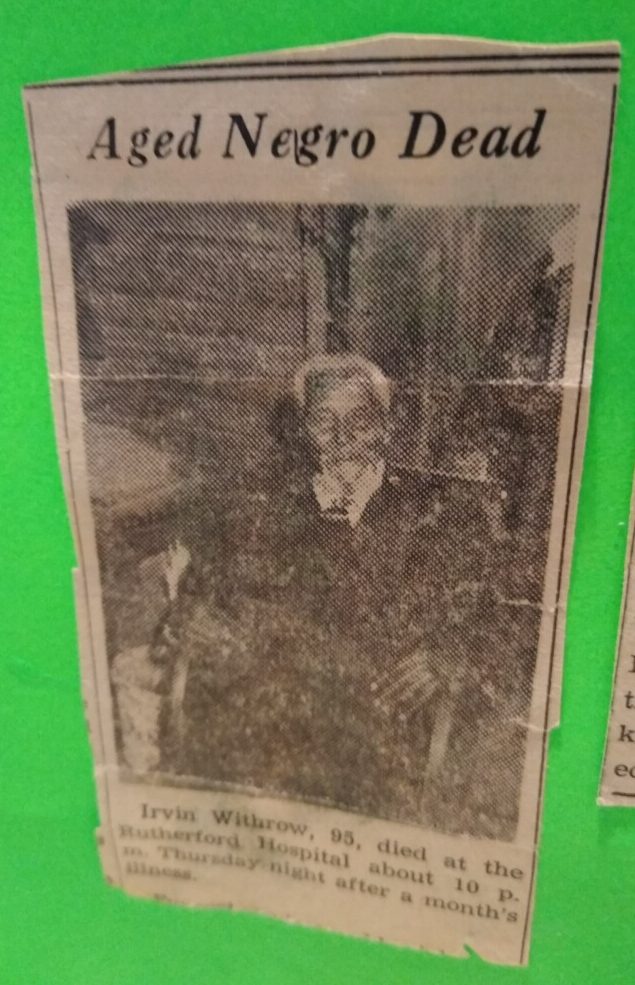
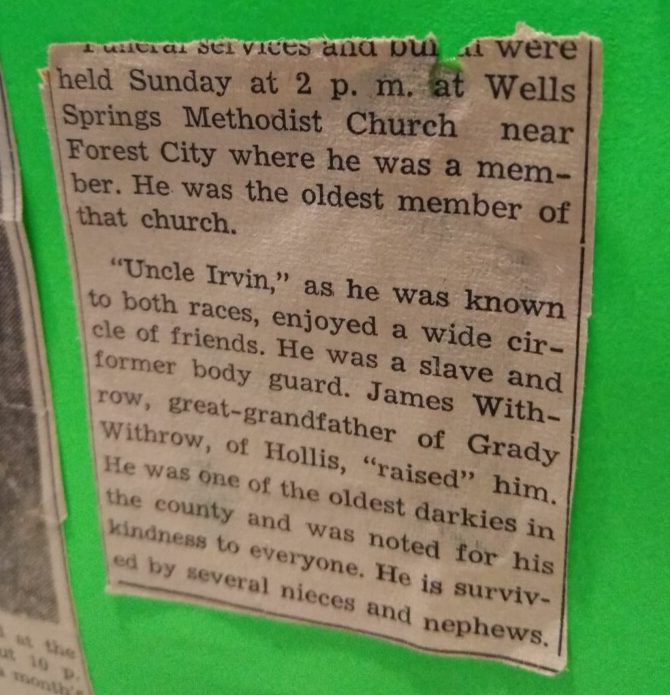
Asheville and Rutherfordton local newspapers announced the March 9, 1950 passing of “Uncle Ervin, one of the oldest darkies in the county.” The news obituaries repeatedly quoted that he had been “raised” by James Withrow, his former enslaver, which omit any recollections of Ervin’s birth parents, Isaic (Isiah) and Jane Wesley Withrow.
Ervin could have been one of the four year old or six year old black males enumerated by James Withrow on the 1860 US Federal Census Slave Schedule, for Flint Hill in Rutherford county, North Carolina. It is likely he was born on James Withrow’s Sandy Run plantation but enumerated on the Flint Hill schedule where the slave owner resided.

In the 1870 US Federal Census, North Carolina, Rutherford, Rutherfordton, he was 14 years old, the seventh child of my great-great grandparents Isaic (Isaiah, Isaih, Isiah) and Jane (Jenny).

Every census 1880-1940 records his age as being younger; however his death certificate is closest to his mother’s report. We see in 1880 that Ervin and his younger brother Chauncey were working on a Sulphur Springs farm of South Carolina-born James Davis, a chair maker.
At about age 27 in 1883, Ervin married Ella Carpenter also of Rutherfordton and they farmed their own land. The 1900 US Federal Census lets us know Ella bore four children but they were all deceased by June 30, 1900. Those children are yet to be identified. Ervin maintained close relationships with South Carolinians in Cherokee and Spartanburg counties as hinted by a mysterious generosity towards such a family in his last wills and testaments: the Cantrells.


Drop a Thought or Question!