“If you don’t know where you are going, remember where you came from.” African proverb
A lost child who is found by the police or a responsible adult is typically asked, “What’s your name? Who are your parents? Where do you live?” These fundamental questions help return the child to safety. Similarly, in genealogical research, we ask these same questions about our ancestors, as though they were still alive, knowing that documented discoveries may differ from oral traditions or family photo albums. While I am not a lost child, as a guardian of my family history, I am responsible for uncovering the true identities and lives of my ancestors. This requires adhering to standard genealogical practices while also thinking outside the box to confirm or refute misinformation and family legends.
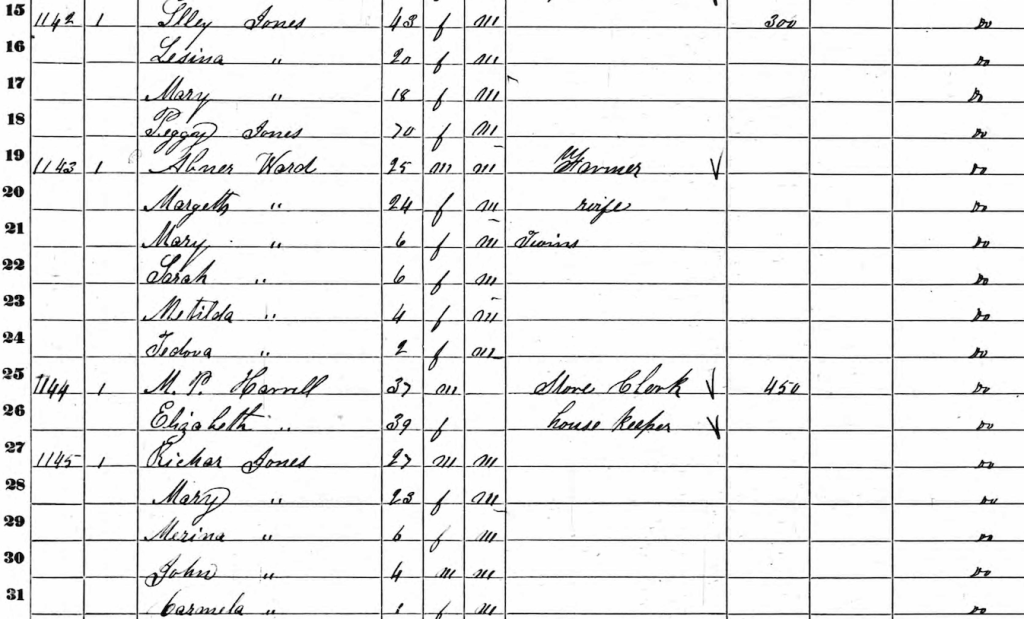
A mystery surrounds the identity of my great-grandmother Margaret Ann Jones’ husband, Abner Ward (also known as Abner Newsome). I first located him as the head of his household in the 1860 U.S. Census for Martin County, North Carolina, District 9 (later Hamilton), page 151, dwelling 1143 (National Archives and Records Administration [NARA], accessed via Ancestry.com). By age 25, he had fathered four daughters, including a set of twins, with 24-year-old Margaret Ann and was farming his own land. All six household members were described as “mulatto,” as were Margaret’s mother, Sally; her two sisters, Lisina and Mary; their 70-year-old grandmother, Peggy, who lived next door; and Margaret’s brother, Richard Columbus Jones, who lived two households away. In 1860 North Carolina, a “mulatto” was counted as a “colored” person, but the definitions of both terms were ambiguous, leaving room for speculation about Abner’s true identity.
When I asked my mother about the woman in a particular portrait (see my post, “Annie, How’s Abner?”), she repeated the oral tradition that her grandmother, Annie (Margaret), was “a white woman, a mixed-breed” who had married Abner, “an Indian.” My mother and her sisters argued until their deaths over whether their Native ancestry was Tuscarora or Pamlico. They cited their eldest sister, Alice Mable (Aunt May), as proof of their Indigenous heritage, claiming she looked “just like Sitting Bull.” I never heard my aunts discuss Abner and Annie directly, but their conversations about “good” hair versus “bad” hair, “high yellow” complexions (colorism), and their perceptions of “highfalutin” people revealed that they had internalized Western standards of beauty, intelligence, and social status. Being of mixed-race ancestry in America has been challenging since the arrival of the first Spaniards, British, and Africans.
In Virginia and North Carolina, where my mother was born and raised, mixed-race individuals—those of Black-White, Black-Indigenous, or Indigenous-White parentage—were subject to numerous laws dating back to the 1600s that significantly impacted them legally, economically, and socially. For example, between 1820 and 1830, the decade in which Abner was born, North Carolina legislation affirmed that free men of color had the right to vote, bear registered arms, and petition the General Assembly, regardless of whether they were free-born or emancipated. As citizens, free people of color exercised these rights, even as an 1821 law permitted an enslaved person’s testimony against a free person in court. This law aimed to equate free people of color with enslaved individuals, thereby diminishing their increasing influence in post-Revolutionary War society, where white men sought to maintain racial superiority. Nevertheless, testimonies from both white and Black individuals who knew industrious free families were acknowledged in court and by the General Assembly.
However, just as Abner’s family was attempting to establish stability and prosper as farmers, an 1827 law prohibited “any free negro or mulatto” from immigrating into North Carolina under penalty of a $500 fine or forced labor. Free Blacks, Indigenous people, and whites frequently crossed state lines to marry, trade, visit relatives, manage plantations, and engage in tribal conflicts. Because Abner’s elders had roots in neighboring Virginia, this law restricted their mobility and disrupted their vital economic and familial networks. Many of our free people of color in northeastern North Carolina—including Bertie, Gates, Chowan, Hertford, Halifax, Martin, and Northampton counties—chose to remain while others migrated to Ohio. The 1827 statute ultimately provided white enslavers with another labor source, as free people of color who crossed the Virginia-North Carolina border without paying the fine could be subjected to servitude under conditions akin to indentureship.
According to Walter E. Millteer Jr., “From the beginning of North Carolina’s postcolonial existence, free people of color and whites cooperated as neighbors and allies.”2 Such was the economic climate in which Abner was born and raised. Did he have the wisdom and guidance of his father to navigate the complexities of being a mixed-race man in the antebellum South? Why did he choose to remain in the predominantly white District 9 (later Hamilton) in Martin County rather than relocate to Ohio, as other Wards and cousins did? By analyzing the 1860 census in which Abner appears and comparing my DNA tested matches, I’ve decided to consider an older mulatto couple enumerated on page 1139, Henry and Polly Ward, as potentially being Abner’s parents.
Identifying Abner’s parents will answer many questions. Fortunately, Abner’s digitized agricultural liens, property records, and census entries from 1860 to 1880 provide additional insights into his life. The treasure hunt is on!
- 1860 U.S. Census, Martin County, North Carolina, population schedule, District 9, p. 151, dwelling 1143, National Archives and Records Administration (NARA), accessed via Ancestry.com ↩︎
- Warren Eugene Milteer Jr., “North Carolina’s Free People of Color 1715-1885”, Louisiana State University Press, 2020, pg. 88. ↩︎
Tags: Ward family, Newsom family, farming, FPOC, indigenous, Martin County
Next: Where’s Abner’s Home-place in 1870?

 Ancestor Talk
Leave a Thought or Question